Showing posts with label culture. Show all posts
Showing posts with label culture. Show all posts
Friday, October 09, 2009
Talking-point pen
I spend most of my time at my computer. And now that I have push email on my phone, it's like I'm carrying around a baby monitor, constantly listening out for the gurgling of an inbox or the wailing of an unread RSS reader.
So it felt very strange indeed to shut down my computer, as I did last week, and sit at a desktop not cluttered with icons and folders but with pens and pencils and actual paper. I thought I'd revisit an old pastime by drawing a relatively new one - my guitar. I'd taken it up when I last eschewed technology, albeit not through choice, when our Internet connection went down at University. (I taught myself how to play 'I Can't Live (If Living Is Without You)' whilst waiting to be reconnected.)
And - do you know what? - it was pretty good! So I signed myself up for a life drawing drop-in session in Islington. "To draw," as I kept telling people. "Not to model!" Like anyone thought that was the case. But it wasn't until I got there that I realised how strange it was - not to be in a room with naked strangers (if anything, it was probably the best way to wean me off the Internet), but to be in a room with strangers altogether...
I work from home and for myself; I rarely have meetings with people I haven't Googled; and I've been with my girlfriend long enough to know all of her friends and for her to know all of mine. And yet there I was, in a room full of strangers, two of them completely undressed, not knowing a single soul.
For the most part it didn't matter. We sat there, scribbling away, trying not to look directly at the penis, as if it were the sun peeking out from a solar eclipse. Occasionally someone would hold up a pencil as if they were trying to block it out completely. But it was quiet and everyone got on with it.
But then the tutor called for a break. 'Oh no!' I thought. 'Chit-chat'. Thinking I could bypass the whole ordeal, I skipped out to the bathroom and stayed as long as I could without appearing to have an actual medical problem. But by the time I got back the students had paired up exactly. There must have been an odd number of attendees - and I was that odd number.
The tutor announced that we had ten minutes left of our break.
'How long is this break?!' I thought. I tried to fill it by alternately looking at my own sketches, which made me feel conceited; by looking at other people's, which made me feel nosy; or by looking at the models, who were now draped in sarongs, sipping coffee. That made me feel more like a pervert than when they were naked. And so I realised that I had no choice but to make conversation.
"That's an interesting pen," I heard one student remark to another. It was my way in, I thought. I'd mention the pen.
"Yeah, you squeeze it to control the flow of ink," replied the other. They were both student age of the conventional sense. Student students.
"That's an interesting pen!" I interjected. It was only when they turned to face me that I realised how close we were all sitting. We nearly bumped noses. There was no way I couldn't have overheard their conversation.
"Yeah," she went on, looking bemused. "You, er, squeeze it."
"Okay, that's time!" shouted the tutor, signalling the end of the break. I wasn't sure whether I was relieved that the agony of breaktime was over or disappointed that I hadn't moved beyond pen chat to redeem myself as a conversational virtuoso. I didn't get another chance. In fact, "that's an interesting pen," was the only thing I said all night. And - do you know what? - it wasn't even an interesting pen. It was a ball-point.


Wednesday, April 09, 2008
Old clothes, new gags at 'Dude Patrol'
I didn't have an excuse. But believe me, I wracked my brains. I wanted nothing less than to go to an interactive comedy night, an hour and a half away in Stoke Newington. But I'm dating again and have fallen into a routine of taking turns to "host". 'Captain Dude and the Dude Patrol', at Ryan's Bar on the Stoke Newington High Street, fell on her day ('her' henceforth referred to as 'my Brooky Wook').
Accepting Brooky Wook's invitation, I thought, might make my turn - inviting her to my ex-girlfriend's house for dinner - a little easier (on me, I imagine, not so much on her). So I said, 'yes,' and rode that Overground, somewhat reluctantly, to the scary, north-east corner of zone 2.
Call me an old curmudgeon, but the idea of painting, of making things, dressing up in old, jumble-sale clothes and competing for prizes, all of which was promised by its Facebook event description, made me want to stay home, wash my hair, catch up on my junk mail correspondence - anything to avoid the kind of interaction with strangers that sounded about as fun as being mugged.
I saw a guy at a comedy night, right here in West Hampstead, whose entire set consisted of a conversation with an audience member, about as engaging as being collared by a high street charity collector. By the end of it, he looked about ready to hand over his Direct Debit details, just so that he could go on with his life.
"The comedy's not amazing," Brooky Wook said, as we took our seats. "But the atmosphere's great." The atmosphere was pretty tense, from where I was sitting. I was terrified of being picked by the compère, Tom Bell, whose sprightly androgyny reminded me of a theme park animal trainer, who once plucked me from a crowd of otherwise happy holiday makers to perform with what wasn't the real Lassie but what looked good enough to pass.
I was 10 years old, and arrived with my family just before show time, managing to squeeze onto the front row of the 'Animal Actors on Location' attraction at Universal Studios Florida. I was aware that because of my proximity to the stage and the ease with which I could get there and back with minimum interruption to the crowd, I had the highest chance of being picked by the animal trainer. I was as terrified of him as I was of the dog, so I did my best to catch neither pair of eyes. But I guess they both smelled my fear and, before I knew it, I was on the stage, shaking Lassie's paw to my obvious embarrassment. (Why can't dogs smell that?)
But here, in the basement of Ryan's Bar, the front row was the only row. I took it with a big swig of my drink and finally relaxed into my seat. If Universal Studios wasn't such a 'dry' theme park, I might have had a better experience. But last night, at 'Captain Dude and the Dude Patrol', I had a surprisingly good time.
Bell made for an excellent compère, as comfortable on stage as he was in the massive "sleeping bag-come-coat" he picked out for himself from the jumble-sale. His comedy partner, Ed Weeks, was late, but no less funny. His punishment from Bell was the accusation of racism, eliciting a chorus of boos from the crowd, triggered by a hand signal designed by Bell in Weeks' absence.
Pippa Evans put in a good turn, acting alongside Bell in episode two of 'Plaice Invaders', the completely improvised soap opera set in a fish & chip shop in space. All of this, set to a soundtrack of the worst charity shop vinyl Bell could find and all the laughter we, in our crowd of 15, could muster.
"If you like finding furniture on the street," the Facebook event description went on, "you'll love Dude Patrol." I do and I did. But unlike stumbling across a broken wicker chair or a discarded coffee table, there was nothing wooden about these dudes. It's a comedy night worth checking out, if you live in the area. I might just make that one and and a half hour journey back out there, next month.
Saturday, February 02, 2008
Coconut Boy
While other mums worry about their sons turning to drugs, getting their girlfriends pregnant or joining some sort of gang, mine is concerned with matters more spiritual. (Besides, I don't have a girlfriend, I'm a responsible member of an online community and I just turned down a line of coke because I had a "terrible blocked nose".) The way my mum sees it, the only road I'm heading down is the one clearly marked, 'Identity Crisis'.
"Coconut boy," she calls me. "Brown on the outside, white on the inside."
While there might, at least, be parts of me that resemble a coconut - brown, covered in hair and full of a white, milky fluid - at this time of the year, when my colour fades, it's quite easy to 'lose my roots' when they're not so etched onto my face in hues of burnt sienna, sepia and mahogany. I'm invited to fewer dinner parties, considered less effective as a token person of colour, and stopped far less by police men.
It takes just a two hour journey up north and one weekend with my family to bring that muddy colour back to my sweet cheeks and to remind me that my roots don't stop in Shropshire, but in a land far, far away, to which ex-pat relatives still squint and admire what remains of a changing culture.
I found out this morning that my cousin, a graduate from Kings College London, is in India to get married.
"That's crazy!" I said. "Has he even met her before?"
"Oh yeah," my mum replied, nonchalantly. "At the engagement party, I think."
He's my second cousin in as many years to go east to find the perfect Indian bride. Some send for the brides to come over to the UK. Others, like my cousin, get married in India with a view to bring their brides home once 'the paperwork' is ready.
On the one hand, I think it sort of represents a failure, as if the groom-to-be was no match made in heaven for the British Indian girls he would have seen on the arranged marriage circuit (which I like to imagine is like the selection process of American Idol; Simon Cowell as busty bride-to-be).
On the other hand, it's like the son or, more often, his parents, look to India for the 'old fashioned decency' quickly escaping British Indian girls. (It's being replaced by ambition, I'm pleased to report.)
What they don't know - or fail to see - is that the kind of girl that insists on a wedding register at the UK Border & Immigration Agency, is probably pretty ambitious. And that India is going through it's own (belated) sexual revolution (after ironically triggering western 'free love' movements of the 1960s and 1970s, with the rediscovery of its ancient culture of sexual liberalism).
The pursuit and purchase of the 'perfect Indian bride' might be more a case for Trading Standards than Border and Immigration control. Ambition and sexual liberalism is completely at odds with the requirements of my cousin, his parents and other British Indians who look to India for 'old fashioned decency', as impossible to attain as the 'impaling on a stake' position of one of its most old-fashioned texts, the Kama Sutra.
Nevertheless, I wish them luck. If I'm like a coconut, and life a box of chocolates, an arranged marriage is like a curry. It's hot, it's exotic, you can pick it up or have it delivered, but soon enough that shit's going to really hurt.
Wednesday, January 23, 2008
Juno is pretty cool
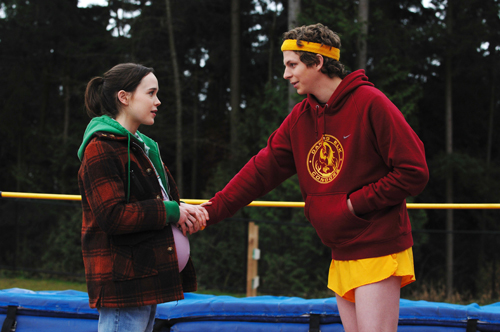
"You're like the coolest person I've ever met," Ellen Page says to a knobbly knee'd Michael Cera at the climax of Juno. "And you don't even have to try, you know."
"I try really hard, actually."
Juno was Fox Searchlight's sleeper hit of 2007, grossing over $85 million in the US (after a modest budget of only $7.5 million). It comes out in the UK on February 8th and I was there at its VIP screening at the Soho Hotel in London last week.
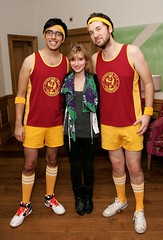 Why am I dressed like a dork?
(If you're reading this through my RSS feed, you might not get the accompanying picture. In any case, it's probably a sensible question to ask - and on most occasions.)
My housemate Bill and I were there to help out a friend, whose event management company was putting on the screening. She needed a couple of geeks to dress up as characters from the film, greet guests and pose for pictures.
"You're like the geekiest guy I know," she said. "You don't even have to try." She was right. I couldn't claim, like Michael Cera's character in Juno, that the accolade was the result of any sort of effort. So, of course, I agreed to do it.
Not knowing much about the film however, I was somewhat unprepared for my costume: a sports vest and shorts, pull-up socks, a wrist and headband. Nevertheless, I left my shame with my trousers, in the cloak room, while Bill joked that stripping down to a pair shorts for £50 might be construed as the behaviour of a couple of "smack heads." We emerged from our dressing room all the same, regretfully sober and ready to face a room full of celebrities.
I joked with British soul singer, Beverley Knight, formed one point of a hip-hop love triangle with So Solid Crew's Lisa Mafia, even went for a post-screening drink with star of zombie film, 28 Weeks Later (and new best friend), Imogen Poots.
But the real star of the night - it's not difficult to say - was the movie itself. A sophomore effort from Thank You for Smoking director, Jason Reitman, Juno is a smart, funny and charming teen comedy, with real affection and wit. Go see it when it comes out here on February 8th (or catch it while you still can, if it's already showing in your country).
It's got an awesome soundtrack (that I reckon will do for The Mouldy Peaches what Garden State did for The Shins); it moves the plot along without being intrusive (take note, Sondre Lerche). And at one point, at the end of the movie, it sort of becomes the plot.
I won't ruin the ending for you. But when the film had finished, and we changed back into our own clothes, Bill joked that it felt good to be 'cool' again. As he did, I caught myself in the changing room mirror, one hand pushing my glasses up the bridge of my nose, the other, buttoning the cardigan that snuggled under my second-hand blazer. I thought to myself that however hard I try, I'll never quite be cool. But that was okay.
In the film, Michael Cera's character got the girl. And there I was at the end of an awesome party, having met some pretty interesting people, £50 better off and about to go for a drink with a movie star? I suppose that is pretty cool.
Catch Juno in the UK on February 8th; find out more on the link below.
- Juno: Official Site - [Fox Searchlight]
Tuesday, December 25, 2007
New hymns
I'm back home with my parents for the holidays, where keeping up with the Jones' has escalated to a point where my family is no longer honouring its own religion, but instead joining the neighbours for midnight mass at the local Catholic church.
It's not typical behaviour for a Hindu family, but then mine has never been a typical Hindu family. Neither has it shied from Catholicism: My sisters and I went to the Catholic school opposite our house. (We got Christ and convenience - it was a 2 for 1 deal.)
As such, we knew what to expect from the service - lots of lengthy Bible passages, lots of time to 'reflect', lots of standing up and sitting down.
I didn't, however, expect there to be quite so many apologies. Soon after we arrived we joined the congregation in one massive plea for forgiveness.
It was a funny way to start, I thought. "Let's get this party started," I imagined the Father saying. "With a big fat, 'I'm sorry'." I wasn't sure why we were apologising (we weren't even late), but I joined in all the same.
It wasn't long, however, until my complicity turned into awkward silence. I was the only member of the congregation not saying 'amen,' 'thanks be to God,' or 'Kyrie Eleison' (I didn't even know what the last one meant, but I liked to think it was Jamaican patois); I was probably the only one censoring parts of Christmas carols, by refusing to sing them.
I wondered how the rest of my family could, not least because the church insisted on performing songs impossible to pick up. New ones, in an attempt to be relevant, employed all sorts of strange 'blue' notes, unpredictable key changes and song structures that eschewed the tried and tested verse/chorus formula of the last hundred or so years.
But then, I thought, that's not unlike my family at all: blue, unpredictable, unusual; also, unlike new hymns, relevant, at least to me. And, in a weird way, honouring its own religion.
Friday, November 09, 2007
In Jobs we trust
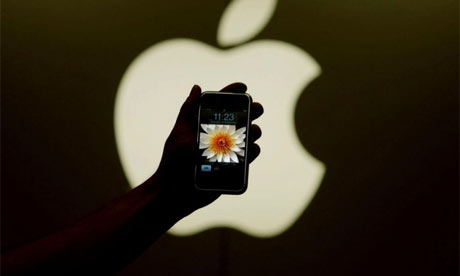
It's the age old dilemma: the secular world versus the spiritual; the things you can't touch and the things you can't stop touching. And this Friday, the conundrum continues, when Apple's long awaited iPhone lands in the UK - on Diwali.
I'd booked the day off work, picked out a traditional outfit, planned my route to the temple (casual shirt, hipster jeans, Central Line to the Regent Street Apple Store). I was all set to get in line and get an iPhone (at 6:02pm - its official launch time, inspired by Apple's O2 partnership), when my mum called.
"Don't forget Diwali on Friday," she said.
Diwali is the Hindu festival of lights. And although the iPhone boasts - amongst other things - a backlit touchscreen, queueing for one on Regent Street is not, apparently, an appropriate way to give thanks to God.
At £269, with a minimum 18 month contract, the iPhone is rather an appropriate way to give thanks to Steve Jobs, blue jeaned and turtle necked co-founder and CEO of Apple, who in September announced the iPhone's arrival in the UK.
"We can't wait to let UK customers get their hands on it," he said.
I can't wait either, Steve. But instead, at 6:02pm tonight, I'll be putting my hands together and celebrating the return of Lord Rama. I'll also be praying that there'll be iPhones in stock by the time I get to an Apple store on Saturday.
But why am I so blasphemingly excited?
Well, the iPhone is, to the mobile phone market, what the iPod is to MP3 players. Neither are the first, but both are quite easily the best - light years ahead of anything else - and clear solutions to the problems that have plagued consumers since computers could talk to peripherals.
For years, you've been able to synchronise your mobile phone with your computer - it's nothing new - but, honestly, who does it (without wincing)?
The software has been clunky, the hardware flimsy and the whole process of navigating your phone awkward and messy. Apple cuts through that predictable haze with a phone that's a joy to use (I know because I've used one), and built on the iPod/iTunes model that's served an unprecedented 119 million customers.
At its price, and worrying O2 lock in, the iPhone might take some time to reach those kind of sales. I don't doubt that we'll see a price drop in the next year (or an iPhone nano), but in the meantime, expect to see iPhone-flourishes in all new mobile phones, as manufacturers step up their game, as they have post iPod.
It looks like we can all give thanks to Jobs. So, this weekend, put your hands together, in your pocket or on your iPhone and have a Happy Diwali/iPhone Day.
- iPhone - [via Apple.com/uk]
Sunday, September 16, 2007
Alphabet Street
When my dad argues that there are thirty more letters in the Hindi alphabet than there are in the English, he refers to the languages as 'ours' and 'theirs', respectively. That's because he's talking to our Indian visitors, who've travelled from Madras, by way of New Jersey, last week to London, and now to Shropshire, where they're staying with my parents and discussing - at length - the respective strengths and weaknesses of Hindi and English. There can't be enough letters in either, I think, as I listen to them debate in an odd fusion of both languages.
Saturday, July 28, 2007
15 minutes
Since the Stephen King/Rob Reiner chillfest, Misery (1990), having a "number one fan" is an altogether terrifying prospect. (A number two or three is fine.)
In the film, a novelist, played by James Caan, is rescued from a car accident in a blizzard, by a particularly fat Kathy Bates. Wait, it gets scarier...
It turns out she's his "number one fan" and has no intention of letting him go. She also lops off his feet with a hammer (don't click this link if you're squimish!).
It's no wonder then that I had cold feet (or any feet at all) when I agreed to meet one of my fans last week. ('One of' suggests there are more; 'one and only' may be closer to the truth.) She'd read my blog, saw that I'd moved to London and wanted to meet up.
Why the hell not? I thought.
Well, there was one prettyyy big reason why not:
- Kathy Bates.
But anyway, I chose to look beyond the Bates and found instead a very charming, not at all psychotic, PhD student.
And it got me thinking, perhaps prematurely, about the notion of fame (and the fifteen minutes of it promised us by Andy Warhol). I realise that it hasn't yet touched me in the same way that it did, say, Princess Diana, but it has sort of tickled me on the nose.
The PhD student knew only a persona, pixelated and preserved on this blog; a "true story of a single, metrosexual, twentysomething, British Indian male."
And while one fan does not a fan club make, I imagine it's just a matter of time before I'm shaving my head and checking into rehab, dangling a baby over a balcony ledge, or dying in a high speed car chase in Paris.
That's a lot to cram into my fifteen minutes.
Thursday, July 19, 2007
Harry Krishna
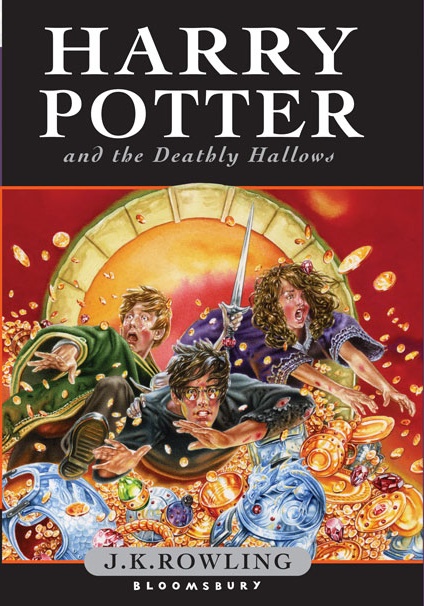
My mate, Peter Woods, kindly pointed out that the Harry Potter pictured on the cover of the new book bears a striking resemblance to a certain...me!
It's uncanny! To the point that he actually looks Asian. Check it out.
- Harry Potter and the Deathly Hallows [Amazon.co.uk]
Saturday, May 26, 2007
Good timing.
I couldn't have timed my return to Shrewsbury any better.
In a strange sort of reverse ethnic cleansing, the beautiful market town I once called home was this weekend left practically empty. Its townsfolk - arguably its least appealing quality - had hit the road to Wembley to support their local team, who in a weird twist of footballing fate were to play in the country's premiere stadium.
The streets were both eerily and delightfully quiet - football fans free to frolic in their fighting someplace else. All but one, I discovered, remained, here at Shrewsbury train station.
"You going to the match?" a lady shouted to another, who stood under the shadow of her hulking, skin head husband. She looked at him.
"Nah," she said.
"Why not?" the other asked. "I didn't think you guys would want to miss it."
"It's, er...him," she said, craning her neck to look up at her man, who had the word 'England' tattooed on the back of his. "He's got a football ban."
With that he bowed his head - partly in shame, I thought. Partly to reveal another tattoo. It was of a dog, burned to his scalp, now forever burned on my memory.
The man had a tattoo of a dog on his head.
Before I had much more time to think about that, my train arrived. I couldn't have timed my return to London any better, I thought. And with that left town.
Thursday, April 12, 2007
Roti and respectability
I've just explained this to a friend and she thought it was hilarious. Hopefully you will too. Hopefully some good will come from my evening, before something bad comes from my mouth.
You see, I'm full. Like really full. I'm so full I can't see my feet.
And it's all because I've just been caught in a cycle of roti and respectability, of cauliflower and chapati.
My aunt, who is staying with us this week, has made alloo gobi - a curried combination of potato and cauliflower, which, she tells me, is disrespectful - for some reason - to eat alone. Not with a loved one, of course (this is the land of the arranged marriage, after all).
"You mustn't eat without chapati," she said.
But it's also quite bad, I understand, to eat chapati alone - without the curried combination of something else. So, imagine my difficulty tonight in trying to synchronise my chapati and my cauliflower.
Each time I finished one I was served more of the other.
And so it went until both were finished at exactly the same time. And most of my lower torso had completely vanished beneath my big belly.
"More cauliflower, Sandeep?"
"No thanks, Aunty ji."
Tuesday, April 03, 2007
The Namesake is super, man
It's no secret that I saw Superman Returns six times last year (and that's not including DVD viewings). I own both Spider-man films, eagerly await the next, and have all but the Joel Schumacher Batman outings.
It's not that I particularly like men in tights, though some may suspect otherwise; or that I have a hero complex, any more than most men.
I suppose I identify with these stories that are, essentially, the stories of immigrants.
Sent from far away places, living with alter-egos, battling with the duality of identity - on the one hand plain and inconspicuous, on the other colourful and foreign - superheroes (powers aside) are your regular, run of the mill, second generation immigrants.
Meera Syal went as far as claiming that Superman himself was Indian in her comedy sketch show, Goodness Gracious Me. NHS glasses, kipper tie..? Where else, she asked, could a man run faster than a train?
It's another Mira (though spelt slightly differently - Mira Nair) that reminds us of this fact. And it's on a train that her new film, The Namesake, begins. It ends the same way and in-between fills its two and a bit hours with, what critic Mark Kermode calls, "issuetastic family drama."
This, from the film's synopsis:
When the the Ganguli family moves from Calcutta to New York, they embark upon a lifelong balancing act to meld into a new world without forgetting the old. Though parents Ashoke and Ashima long for the family and culture that enveloped them in India, they take great pride in the opportunities their sacrifices have afforded their children. Paradoxically, their son Gogol is torn between finding his own unique identity without losing his heritage. Even Gogol's name represents the family's journey into the unknown.
Though I might rather relate to the Super side of Superman, his alter-ego, and that of the unfortunately named Gogol Ganguli, strike a more notable resemblance.
In The Namesake, Gogol's experiences were very much like mine. I cringed watching him bring home a white girl to meet his parents, flinched as she put her hand on his during dinner and squirmed as she planted an awkward kiss on his father's cheek. We just don't do that, my mum says.
I wondered what it must have been like for her, being born in India, coming over to England as a child and raising children of her own - 'neither here nor there'.
I wondered how she must have felt when I, like Gogol, disappeared into the surrogate family of my girlfriend, my work and my country.
Like all second-generation immigrants, I suppose, Superman himself is torn between two cultures - taught to respect his Kryptonian heritage, whilst embracing his undeniable Americanism.
The actor who plays Gogol Ganguli (Kal Pen) was, incidentally, in Superman Returns. It was a non-speaking role... You notice these things when you watch a film several times!
The Namesake was brilliant. I urge you to see it at least once.
- The Namesake [Fox Searchlight]
Sunday, March 11, 2007


Sunday, February 25, 2007
Thursday, January 18, 2007
Death of a celebrity

In the eastern Indian city of Patna protesters are burning an effigy that is said to resemble the organisers of Channel 4's reality TV show, Celebrity Big Brother. It looks very much to me like a standard, two plank wooden frame, cloaked in a burning white salwar kameez. Now, I've met John de Mol, co-founder of Endemol, the production company behind the Big Brother franchise, and he is definitely a jeans/sports jacket kind of guy.
Some four thousand miles west and Patna's favourite Bollywood actress, Shilpa Shetty, sits under the surveillance of de Mol's creation - the Big Brother house - caught by the lens of 36 surveillance cameras and the attention of the world's media.
Shetty, 31, is the unwitting subject of a racism row. Her treatment by fellow housemates has generated a record 30,000 viewer complaints and has sparked a national debate on bullying, class and race.
Whether you think her tormentors are racist or not, Shetty has been on the receiving end of some sort of sinister bigotry. And its origins, whether in cultural ignorance, jealousy or arrogance, is a story that needs to be talked about: it is the story of racism in this country.
The name calling, the back stabbing, the bitching, is not unusual in a television show of this nature. But it has become a vehicle for an issue that is as uncomfortable to discuss as the show is to watch.
Does Big Brother reflect society? And if so, are we a racist nation?
Shetty's biggest opponent in the Big Brother house is former contestant Jade Goody, who left series three in 2002, nominated by the public, denounced by the British tabloid press and met with a crowd of booing protesters. Since, she has returned to television, relauched her career and amassed a not inconsiderable fortune.
It's interesting, as a subplot to this series of Big Brother, that we may be witnessing a turning of the tide against the post-Heat notion of celebrity; that we are fed up with what is being celebrated; that it is no longer intelligence, artistry and achievement.
It is predicted that Jade will be the next contestant to leave the Big Brother house. When she does I suspect she will be met with another booing crowd, and that we may see another burning effigy.
Monday, January 01, 2007
Happy New Year and that.
I figured I'd be excused for my lack of Christmas spirit this year on account of my Hinduism, which - as you know - seems to come and go. In any case, I apologise for a quiet couple of weeks. And, while I'm late in wishing you a Merry Christmas, Hinduism is really no excuse (even if the calendar itself is Judo-centric) - and so I wish you all a very Happy New Year and all the best for 2007.
Monday, November 13, 2006
Washed Up
When I moved out of my family home into my own place one of first things I bought was a plastic washing up bowl. It's more symbolic than it sounds.
To me, it, and all the new kitchenware I'd bought, represented a new independence and a break from the Indian culture on which I was raised.
I'd never seen a washing up bowl until I went to my girlfriend's house. English people, I discovered, put their dishes in this bowl, soaked them in hot water and, some time later, rinsed them off. It seemed to be the antithesis of the Sisypheon ordeal that was washing up in my house.
My long suffering Mum stood making hot chapatis while we ate, and somehow managed to finish hers first and be at the kitchen sink quicker than we could say alloo sag. (My pronunciation always slowed me down somewhat.)
There would be no after dinner conversation. The trays had to be washed - jaldi, jaldi - before the colourful culinary delights left stains in their steel compartments. Mum would stand, hunched over the sink, scrubbing the trays as they clanked, one by one, before her.
The plastic bowl, I observed, allowed my girlfriend's family to dispose of waste liquid into the sink, whilst keeping the washing up water relatively clean.
It was perfect, I thought. While the dishes soaked I could...listen to Radio 4, read the newspaper, have a glass of wine - do all the things we never did in our house. I could...be white and middle-class. All thanks to a plastic washing up bowl.
It wasn't long, however, after moving into my own place that I began to find the plastic bowl a bit cumbersome. I couldn't get much in it and I didn't get much out of it. It just became another thing to wash up. And while I let things soak I realised that I didn't care much for Radio 4, I never bought the paper and I didn't know how to drink wine without getting drunk.
I took it out of the sink. And my washing up bowl, for some time, became my fruit bowl.
Some say multiculturalism is a melting pot. I think it's more a plastic washing up bowl. And I've decided - and can only imagine its cultural ramifications - that I'm getting a dishwasher.
Sunday, November 12, 2006
Borat. And mixing with the wrong crowd.

I went to see Borat for the second time yesterday. But I don't imagine it'll become the multiple viewing experience Superman Returns was. In fact, the first time I went to see it I didn't see it at all. I made the mistake of going on an Orange Wednesday, when mobile phone customers get two-for-one cinema tickets, saw the enormous queue of Borat fans, turned around and walked home.
I was put off, not exactly by the size of the crowd, but by its components. And that sounds like a terribly snobby thing to say. But, to quote the Onion, stereotypes are a real time saver, and just a glance at the crowd revealed a group of people probably unable to separate the irony from the racism, misogyny and anti-semitism of Borat.
The genius of Sacha Baron Cohen's creation is that it makes its point by seemingly embracing these bigoted ideas, turning the mirror on its subjects and making us question the boundaries of humour. When I finally saw the film yesterday I found that my stereotyping was spot on, that the crowd, which I'd tried to avoid by going to the matinee, asked no questions of its humour, instead erupted into hysterical laughter without the slightest delay.
I was, and not for the first time in Shrewsbury, immersed in a crowd with whom I shared little in common. And it made me feel as uneasy as Borat's tasteless gags. If you don't see these as satire, I thought, you are essentially laughing at racism, misogyny and anti-semitism. Were these people, I thought, looking at the crowd, the ones accusing me of terrorism? Calling me "über-gay"?
Is it good satire? It is occasionally. I liked when he lambasted people who deserved to be lambasted (and not just because I like to use the word 'lambast'). The frat boys in the Winnebago were truly horrible racist, sexist bastards. The scene in which Borat fearlessly strides into a Texan rodeo ring and loudly praises his hosts' "War of Terror" to wild applause is brilliantly surreal. But picking on shopkeepers by smashing their cheap antiques or presenting Atlanta folk with a bag of his after-dinner poo is just bullying one step up from Jeremy Beadle.
Is Borat funny? Yes, it is, and fine TV. And perhaps that's how it could have been better enjoyed, on the small screen and with like minded people, with whom I could have been sure to share the joke. But yesterday, I think, I was sitting in the wrong crowd.
- Stereotypes Are A Real Timesaver, The Onion
Friday, September 01, 2006
Surely, quote of the day.
"They wanted to set an example out of me... Who knew the black buck? I mean today because of me, people know there's an endangered species of deer called black buck, well it's actually an antelope."
Salman Khan
BBC News
Tuesday, March 21, 2006
Postcard from a Convenience Store
Behind the convenience store counter sat, what I've been told is called, an NRI - a non-resident Indian.
The top half of his face hid under the shadow of his baseball cap, which nodded both to the San Francisco Giants and to the tallish NRI standing at the counter, handing over his driving license.
I was buying booze.
As he stood to serve me I noticed that from under his baggy jeans shone the ruby jewels of his fancy slippers.
These were not the shoes of an American football fan. Nor were they the comfortable footwear of a convenience store clerk.
The stones were sewn into white satin and glistened as he walked, with surprising grace, over to the cash register.
These were, I realised, the slippers of a bhangra dancer.
He noticed me smile and turned up the volume on his radio. It was the familiar locomotive beats of bhangra music.
My feet shuffled, we spoke a little Punjabi and the drinks were on the house.
Subscribe to:
Posts (Atom)